
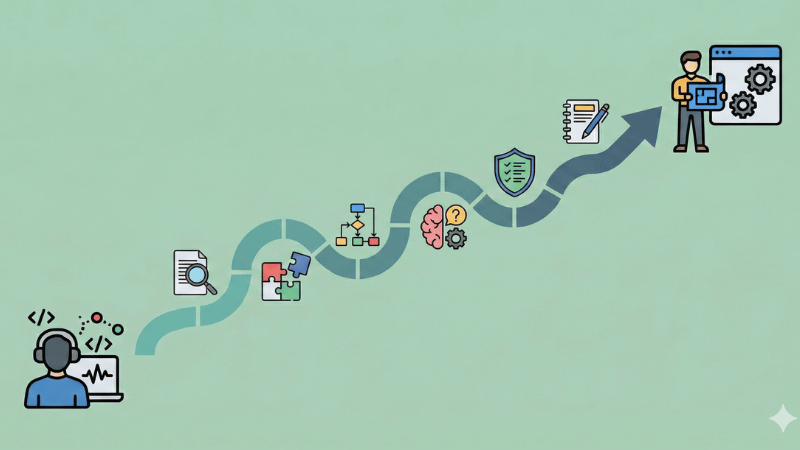
From Vibe Coder to Product Builder for Lasting Career Success
AI coding assistants have given rise to a new breed of creators who can build software by simply “vibing” with AI, describing what they want and letting the AI generate code. This approach, dubbed vibe coding, was popularized by AI expert Andrej Karpathy as a way to “convert natural language instructions into working code” while you “fully give into the vibes… and forget the code even exists”. It’s an exciting shift that enables non-programmers to prototype apps rapidly using tools like ChatGPT, Claude, or Cursor. However, being a “vibe coder” isn’t a formal profession, it’s a technique. And as many have learned, vibe coding without proper structure can lead to messy results (often called “AI slop”) and serious pitfalls in real-world projects.
To build production-ready software, one must go beyond vibe coding and become a Product Builder, someone who uses those same AI coding tools, but with planning, design, and systems thinking guiding the process.
In this article, I’ll outline the differences between vibe coders and product builders, and how you can transition from the former to the latter.
Who and what is a Vibe Coder?
A vibe coder is someone who uses AI to build software without writing the code themselves. Instead of carefully crafting code, vibe coders describe what they want in natural language, iterating through prompts and conversations with an AI until something works. They might say “Build me a simple to-do list app” and let the AI handle the heavy lifting of coding. Vibe coders are energized by how quickly they can bring ideas to life, creating prototypes and solving small problems in a conversational, trial-and-error workflow. This style of development “prioritizes flow, iteration, and structured prompting over rigid process”.
Vibe coding feels more like jamming with an AI partner than following a strict engineering plan.
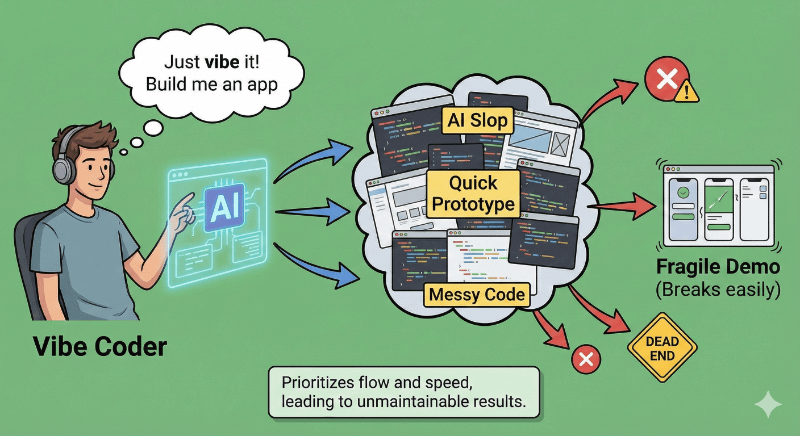
The appeal is that vibe coding dramatically lowers the barrier to turning an idea into a working demo. It allows people with great ideas (or domain expertise) but without traditional programming skills to build things themselves. Many product managers, designers, marketers, and other domain experts find this empowering. Instead of being gatekept by code, they can focus on the what and why of a solution, and let AI handle the how. Early successes of vibe coding hint at a future where software emerges from the people closest to the problems, not just professional engineers.
There is a problem we must address: Vibe coding will only get you so far. By its nature, vibe coding lacks upfront design and can produce quick-and-dirty code. Without planning, the AI may churn out a “messy pile of slop that doesn’t work” one moment and a decent snippet the next. It’s fine for throwaway prototypes or one-off scripts, but when a project grows in scope, things often break in ways the vibe coder isn’t equipped to fix. As the official definition puts it, vibe coders tend to avoid examination of the code and focus on experimentation over code correctness. This can lead to fragile software: you might have a demo running today, but “dig a little deeper” and you’ll find missing pieces or hacks that won’t stand up in production. Vibe coders often “hit walls when projects grow, requirements change, or you need to maintain what you’ve built”.
In complex applications, simply prompting the AI more won’t save you when you don’t understand the underlying system.
Critics of vibe coding point out several serious issues that arise without a more structured approach:
Lack of Maintainability and Scale: Code generated via ad-hoc prompts can be inconsistent or poorly structured. It may work initially but becomes impossible to extend or modify without breaking. In a production setting, this creates “technical debt, opacity, and fragility” in the codebase. Down the road, upgrades turn into minefields and every update risks introducing new bugs because “no one really knows how the code works”.
No Systems Thinking: Vibe coding alone doesn’t enforce thinking about architecture or how pieces fit together. The AI will gladly generate code for whatever you ask, even if the overall design is flawed. The result can be a disjointed product. For example, a vibe-built app might work in prototype form but lack proper data management, error handling, or separation of concerns. There are security concerns as well. Without understanding what to ask for, a vibe coder can inadvertently create vulnerabilities. Real incidents have shown AI-generated apps exposing API keys, bypassing authentication, or failing to implement basic security checks.
Debugging and Accountability: When the AI writes all the code, who is responsible when something breaks? Vibe coders can find themselves stuck when the app doesn’t work, because they never really saw or wrote the code that’s failing. If you don’t know how to debug or why the code works, you’re at the AI’s mercy. This is why seasoned developers often criticize vibe coding, not out of elitism, but because they see the potential for unmaintainable “black box” systems. In professional environments, unchecked vibe coding can lead to a lack of accountability: when half the code was written by an AI, who will ensure it meets quality standards or fix it when it fails?
Vibe coding can be fast, fun, and powerful for quick wins, but on its own it can devolve into “just winging it” development. The good news is that vibe coding does have a place in serious software development, but only when combined with proper guidance and structure.
This is where the Product Builder comes in.
Who and what is a Product Builder?
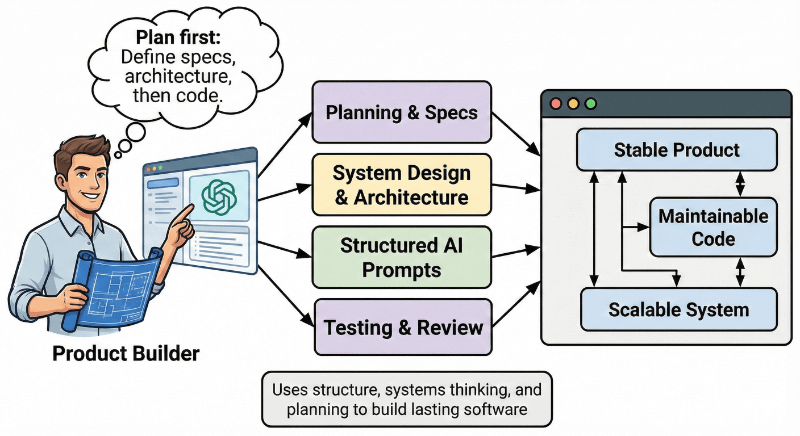
A Product Builder is someone who builds software products with AI, rather than letting AI run wild. In practice, a product builder will use the exact same AI tools and vibe coding techniques as a vibe coder, but with a crucial difference: they design, plan, and architect the system with AI before any code is written by AI. As the name implies, a product builder thinks like a product person, not a coder. They care about the end-to-end solution including the user needs, the features, the maintainability, the business value and they use AI as a coding assistant to achieve those goals efficiently.
Importantly, a product builder does not have to be a professional programmer. In fact, many product builders come from non-development backgrounds: product managers, entrepreneurs, UX designers, business analysts, marketing professionals, project managers, essentially, domain experts who know the problem space deeply. They don’t code, but have a mindset of systems thinking and product design. As AI tools remove the barrier of needing to write every line of code, these individuals can step up and orchestrate the creation of software. “Coding with AI” isn’t a skill just for developers, it’s a core skill for anyone who needs to turn ideas into working software quickly. In other words, the builder role is a natural extension of what these domain experts already do, understand user problems and envisioning solutions, but now empowered by AI to also implement those solutions.
So how does a product builder operate, in contrast to a vibe coder?
Guided by Structure and Plans
A product builder approaches an AI development session with a plan in hand. Rather than jumping straight into prompts, they start by defining the specifications of what they’re building. In the same way a software engineer might create a design doc or a blueprint, the product builder will outline features, user flows, and requirements, often with the help of AI as well. This approach is sometimes called Spec-Driven Development (SDD) where you and the AI collaboratively draft a spec before any code is written by AI. By clearly defining the project and breaking it down, you ensure that “you and AI share the same understanding of the product”, which reduces rework and makes development more efficient and consistent. In short, the product builder minimizes the potential AI chaos with design and direction.
Systems Thinking and Architecture
Product builders think like architects. They consider how different components of the app will interact, how the data flows, what the tech stack should be, and how the system can scale or evolve. Even if they rely on AI to generate the code, they decide the overall architecture, most of the time, with the help of AI. One hallmark of a product builder is being a “systems architect who sees how components connect and designs for scalability from the start”. For example, before asking AI to code a feature, a product builder might sketch out (in natural language or diagrams) the modules needed.
We’ll need a backend API with these endpoints, a database with
these tables, and a front-end UI that fetches data via these APIs.
By giving this structured guidance to the AI, the output is far more likely to be coherent and scalable than if one just vibed each part in isolation. In essence, the product builder provides the blueprint, and the AI fills in the code.
Focus on Outcomes and Users
While a vibe coder might be satisfied once “it works” on a technical level, a product builder cares whether the feature actually solves the user’s problem or fits the product’s goals. They are “solution-oriented problem solvers who focus on outcomes, not just features”. This means they use AI coding in service of a clear vision: they can articulate why a feature is needed and what success looks like. This mindset helps in guiding the AI, if the AI’s output doesn’t meet the real requirement, the product builder knows to steer it in a different direction. Moreover, product builders keep the user experience in mind; they won’t blindly accept AI code that technically functions but delivers a poor UX or an inconsistent flow. They iterate with the AI not just to refine code, but to refine the product behavior.
Methodical and Quality-Oriented
Product builders bring discipline to the vibe coding process. They treat AI as a junior developer who still needs guidance and review. Thus, they adopt best practices to ensure quality and consistency. For instance, a product builder will often break tasks into small, manageable prompts rather than asking the AI to build a huge feature in one go. This strategy yields more focused, high-quality code. They avoid scope creep during an AI coding session, logging extra feature ideas for later rather than derailing the current plan. And crucially, they test and validate the AI’s outputs. If something doesn’t work or doesn’t make sense, the product builder debugs it (possibly with the AI’s help) or asks the AI to explain the code. In other words, they don’t treat AI as an infallible oracle, but as a tool to be checked and corrected. This methodical approach prevents the “garbage in, garbage out” problem. A product builder won’t “just cut and paste whatever the AI outputs”, they carefully review and integrate it, avoiding the trap of AI-generated garbage.
Documentation and Collaboration
Another key trait is that product builders make sure the project remains understandable to humans (not just to the AI). They document key decisions, maintain some form of project notes or specs, and organize the code and prompts in a logical way. Why? Because eventually others might join the project, or the project will need updates that require context. Being “collaboration-ready” means the work is not locked in a private conversation between one person and an AI; it’s captured in a form that a team can review. For example, a product builder might use version control properly, write a README, or keep a changelog of features built via AI. This contrasts with the lone vibe coder who might have a hard time explaining how the app was built or what exactly the AI did. In a professional setting, this documentation and clarity are essential for teamwork and long-term maintenance.
In short, Product Builders don’t write code, AI handles that, but they use structure, frameworks, and systems thinking to guide the AI. The result is that they can build consistently, efficiently, and at scale because they understand architecture and the software development lifecycle (SDLC). They are effectively the architect/conductor to the AI’s coder/musician. This approach yields apps that are production-ready and maintainable, rather than one-off experiments.
Vibe Coder vs. Product Builder: Sample Prompts
To crystallize the contrast, let’s compare the vibe coder approach with the product builder approach on a few important dimensions:
| Category | Vibe Coder | Product Builder |
|---|---|---|
| Planning | “Build me a blog website” | “I need a blog site with a post database, an admin editor, and a public page. Let’s outline those components first. Also look at my preliminary attached UX.” |
| Architecture & Design | “Let’s add a comments feature to my blog” | “How can comments integrate with our existing data model? Do we need to update it? What would that look like if I want to reuse it in various places?” |
| Error Handling & Quality | “Thank you, it works!” | “Write unit tests for this function and show me how we handle invalid inputs.” |
| Speed vs. Stability | “Make it work right now, whatever it takes.” | “Let’s build a solid foundation first, we can iterate faster later with proper structure.” |
| Mindset | “It’s working, We’re done!” | “It’s working now, but how will it handle thousands of users? Also, any security ramifications we should consider?” |
In summary, a vibe coder is like a chef who throws ingredients together by intuition each time (sometimes delicious, sometimes a mess), whereas a product builder is like a chef who writes a recipe and refines it, so the dish is consistently excellent and reproducible. Both are using creativity, but one adds more discipline to ensure quality results. The future of AI-assisted development will belong to those who combine “the vibes” with knowledge and structure.
How to Transition from Vibe Coder to Product Builder
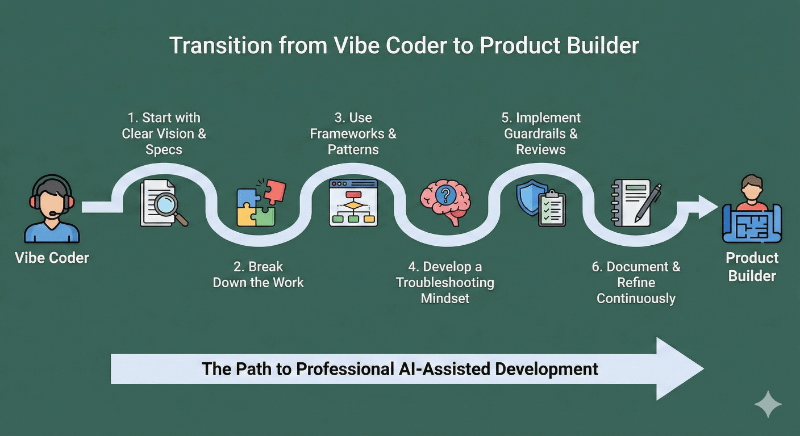
If you see yourself in the description of a vibe coder, great at ideation and prototyping with AI, but running into brick walls when things get complex, don’t be discouraged. You already have the most important ingredient: initiative to build. Now it’s about leveling up your approach to become a true product builder.
Start with a Clear Vision and Specs
Before typing a single prompt to generate code, take a step back and define what you’re building. Think like a product manager about the goal of the application or feature. Write down (in plain language) the core idea and the requirements. Ask yourself: Who is it for? What problem does it solve? What are the main features? If you can’t explain your project in a couple of sentences, you’re not ready to build. Clarity here will save you countless AI interactions because both you and the AI will be aligned on the vision. You can even use AI to help write a spec document, help you refine the idea and question you until you truly understand what you are trying to build. This is the essence of Spec-Driven Development: “clearly defining what you’re building before AI writes any code”, via feature definitions, user stories, etc.. By doing so, you reduce wandering prompts and ensure the AI’s output stays on target.
Break Down the Work (and iterate step-by-step)
Vibe coding often fails when you tackle too much at once. Large, vague prompts lead to generic or buggy results. Instead, divide your project into manageable pieces. For example, rather than telling the AI, “Build the entire user registration system for my app,” you might break it into: (a) design the database schema for users, (b) build an API endpoint for registration, (c) create a front-end form for signup, (d) implement email verification, etc. Tackle these one by one with focused prompts. This modular approach has several benefits: you can test each component as it’s built, you can swap out or refactor parts without affecting everything, and you keep the AI (and yourself) focused. It aligns with good software engineering practice of incremental development, just applied to an AI-driven workflow. As you complete each piece, verify it works and meets the spec before moving on. This way, you’re constructing a reliable system step by step, rather than gambling on one big AI-generated code dump.
Use Frameworks and Proven Patterns
One advantage of being a product builder is that you can incorporate established best practices and frameworks to impose structure on AI coding. For instance, if you’re building a web app, choose a known architecture (MVC, clean architecture, etc.) and have the AI follow it. You might say, “Let’s use a Model-View-Controller pattern. First, AI, generate the data model for X. Now generate a controller for Y that uses that model,” and so on. You can also leverage specialized frameworks designed for AI development. Our Cody Product Builder, for example, encourages breaking projects into versions, writing specs, and maintaining a backlog, essentially project management for AI-built apps. Using such frameworks or methodologies can keep you on rails. At minimum, adhere to the principle of consistency: pick a tech stack and pattern and stick to it. If you prompt the AI with consistent style and constraints, you’ll get more uniform output. Remember, AI has read all of StackOverflow, if you ask it to implement something following industry best practices, it often can. Stick to a mainstream, well-documented tech stack so that both you and the AI are on familiar ground. This reduces weird errors and makes it easier for you (or other humans) to understand the code later.
Develop a Troubleshooting Mindset
Transitioning to a product builder means embracing parts of the traditional developer mindset, especially when it comes to debugging and learning. You don’t need to become a coding wizard, but you do need a learning mindset when something goes wrong. Instead of being stumped by an error, get curious. Use the AI not just to write code, but to explain code and errors. For example, if you encounter a bug, you can copy the error message or problematic code and ask the AI, “Why might this not be working? How can we fix it?” Leverage the AI as a tutor. When ChatGPT or Claude generates code for you, ask it to explain the security implications, ask it what could go wrong, ask it what you’re missing. This way, every AI coding session becomes a two-way conversation: not just “do this for me” but also “teach me what you just did”. Over time, you’ll build up your own knowledge of software architecture, security, and good coding practices, exactly the knowledge that separates product builders from vibe coders. By continuously asking “why” and “how” as you build, you ensure you’re not flying blind. It also makes you less dependent on one specific AI tool’s outputs, because you’ll understand the code’s intent and can verify or tweak it independently.
Implement Guardrails and Reviews
Even with careful planning, AI can produce faulty or insecure code. Product builders therefore set up guardrails to catch issues early. This can include writing tests (and yes, you can ask AI to draft tests), running code through linters or static analyzers, and doing code review, either by yourself or even by using a second AI to review the first AI’s output. For instance, after the AI writes a chunk of code, you could prompt, “Review the above code for any potential bugs or security vulnerabilities.” AI is surprisingly good at critiquing AI-generated code when asked. Additionally, mind your dependencies and configurations; AI might introduce an outdated or suboptimal library, double-check these choices. Ensure things like secrets (API keys, passwords) are not hardcoded (a common AI mistake), and that database operations, auth checks, etc., follow best practices. If in doubt, bring in a human expert for a quick review, especially for critical areas (security, payments, etc.). The extra time spent here can save you from the “firefighting” scenario later. Remember, “you can’t secure what you don’t understand”, so either gain the understanding or consult someone who has it.
Document and Refine Continuously
Throughout the process of building with AI, keep notes about decisions and assumptions. Maintain a simple document (even if just a text file or wiki) where you record things like: what features are completed, what is the API contract, what needs further work or testing, and what ideas are shelved for future. This habit makes you think clearly about the project structure and also leaves a trail that others (or future you) can follow. Each time you complete a component, do a mini “retrospective”: Did the AI produce good code for this? Could I have prompted it better? For example, you might realize after building two features that the prompts which included a high-level outline yielded better results than those that didn’t. Adjust your prompting strategy accordingly, refine your instructions as you learn. In a sense, you are training yourself to guide the AI better. Over multiple projects, these lessons accumulate and suddenly you find you can tackle bigger, more complex builds without chaos, because you’ve developed an intuition for how to keep the AI on track. This continuous improvement mindset is what turns a one-time vibe coder into a seasoned product builder.
By following these steps, you’ll find that you still harness the speed and creativity of vibe coding but you’ve augmented it with the thinking and rigor that professional software development demands. The reward is that you can create truly useful, reliable software products as a non-traditional developer. You’re no longer just demoing ideas; you’re shipping apps that real users can depend on.
The Future: Embrace the “Builder” Mindset
It’s worth emphasizing that vibe coding vs. product building is not an either/or choice, they are phases in a journey. Many people start as vibe coders, excited by how quickly they can turn thoughts into prototypes with AI. That’s a wonderful development in the tech world: more people than ever, from diverse backgrounds, are trying their hand at building software. The next step of that journey is realizing the limitations of wild-west vibe coding and adopting the builder mindset to go further. In the near future, we can expect organizations to expect their team members to have this skillset. Today it might be novel for a marketing manager to also be able to prototype a custom tool, but tomorrow it could be an expected part of the role. Those who combine domain expertise with AI-assisted building skills will be highly valued, because they can solve problems end-to-end. No one is saying everyone must become a hardcore coder; rather, the definition of “coder” is broadening.
Knowing what to build is becoming as important as knowing how to code, since AI can help with the coding part if you guide it well.
For those coming from a non-engineering background, this is encouraging. Your knowledge of your field, be it healthcare, finance, education, marketing, you name it, combined with some product building chops can allow you to create tools tailored to your domain’s needs. You understand the problems deeply; now you have AI as a partner to implement solutions. This convergence of domain expertise and AI-driven development is exactly what the Product Builder concept is about.
Recommended Next Steps
To level up from vibe coder to product builder, focus on two growth paths: learning the basics of building software and learning how to use AI tools as partners in that process.
Learn the Basics of Building
These are the fundamentals that give you the vocabulary, confidence, and perspective to guide AI effectively.
- Learn the basics of the SDLC such as planning, designing, building, testing, shipping, and maintaining software.
- Understand what a frontend and backend are and how the user interacts with both.
- Learn how data flows through an application via databases, APIs, requests, responses, and data models.
- Practice writing small specs before coding by using simple language, clarifying goals, features, and user outcomes.
- Build small projects using structured prompts by breaking a feature into steps and guiding the AI with a clear plan.
- Review AI generated code regularly by asking the AI to explain the code and point out potential issues.
- Learn a little git version control to help keep your project organized and reversible.
- Adopt simple architectural patterns such as MVC, client server, or modular components to give AI guardrails.
- Document as you go by capturing decisions, APIs, prompts, and specs so you can scale and collaborate.
- Practice debugging with AI by pasting errors, asking questions, and learning how systems fail and recover.
- Study examples of real apps by looking at open source projects and observing how they are structured.
- Keep learning foundational concepts that help you steer the AI with confidence.
Learn the AI Tools That Will Amplify You
These tools bridge the gap between your ideas and working software. They support specs, architecture, prompting workflows, and code generation.
- Move beyond platform locked AI builders such as Lovable, Replit, Base44, V0, and similar services that hold you inside their environments. These tools are great for early experiments, but as a Product Builder you want full control of everything.
- Explore AI helper toolkits like Cody Product Builder, SpecKit, and similar tools that help refine ideas and guide you through the building process.
- Use Copilot, Claude Code, Codex, Gemini, or other AI development agents for fast iteration, scaffolding, and debugging.
- Use ChatGPT or Claude AI outside of coding agents to plan features, ask questions, refine ideas, and learn core concepts.
- Learn how to use coding environments such as Microsoft VS Code, Cursor, Google Antigravity, and others that integrate AI directly into your editor.
- Understand what different AI agents are good at since some are ideal for planning, some for architecture, and some for rapid coding.
- Experiment with multi agent workflows such as using one agent to plan, one to write specs, and one to code.
- Have AI generate project artifacts like architecture diagrams, ERDs, flowcharts, API contracts, user stories, acceptance tests, and backlog items.
- Learn how to structure your prompts for building since structured prompts lead to more reliable AI output.
- Ask the AI to teach you the fundamentals of frontend, backend, databases, testing, architecture, and security.
- Leverage AI as your tutor, architect, and developer by assigning it roles and responsibilities inside your workflow.
- Use AI to understand and navigate existing codebases by asking it to explain files, flows, dependencies, and architectural decisions.
- Use AI to bootstrap full project environments including folder structures, dependencies, config files, linting, testing, and deployment scripts.
- Practice AI assisted refactoring and cleanup by asking the AI to reorganize code, simplify logic, improve names, and apply patterns.
- Use AI to explore alternative designs by asking for multiple architectural options, pros and cons, and recommendations.
- Have the AI identify edge cases and risks by asking what could break, what is missing, and what should be secured.
In conclusion, “vibe coding” is an amazing new technique in our toolbox, but it’s not the solution or a professional end goal. It’s the starting point of a new way to build. To go from a fun prototype to a lasting product, you need to add structure and intentionality, you need to become a Product Builder.
By planning ahead, thinking in systems, enforcing quality, and continuously learning, you can avoid the trap of AI-generated slop and instead build software that is both fast to create and built to last.
Happy building!
About the Author

Marcelo Lewin, Founder @ iBuildWith.ai
Marcelo is the founder of iBuildWith.ai and a Principal Content Architect and Builder at Cigna. He has over 30 years of experience in the tech industry. Having lived through the computer, internet, and mobile revolutions, he is now excited and focused on navigating the AI revolution by helping non-developers build real applications using AI. He founded several startups and held roles at various companies including Toyota, NBC, J.F. Shea, and Walt Disney Imagineering.