
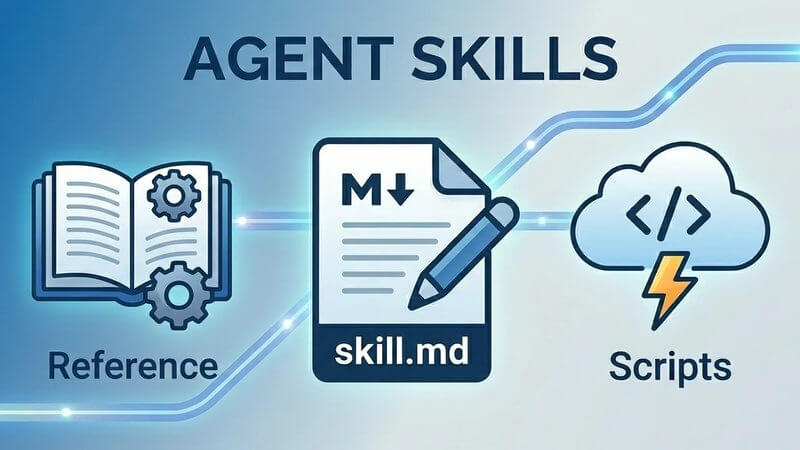
An agent skill is a reusable package of instructions, knowledge, resources, and tools that teaches an AI agent how to perform a specific kind of work. Here is the shape of the workshop, and the seven ideas it is built around.
If you use an AI assistant for real work, every conversation starts from zero. You re-explain your brand voice, your research process, your review checklist, the format your team expects. The answer comes back good enough, the window closes, and the knowledge goes with it.
A skill is how you stop doing that. You capture the process once and give your agent a repeatable way to apply it when the situation calls for it. Your expertise stops living only in conversations and starts becoming reusable infrastructure.
That framing is where this workshop starts.
How the Three Hours Run
- Fundamentals. What a skill is, how agents discover and load one, and progressive disclosure.
- The design decisions. Instructions versus reference, judgment versus determinism, structure, and composition.
- The lifecycle. Testing, debugging, versioning, and evolving a skill as your process changes.
- Hands-on. Build a skill from your own work, test it against real scenarios, and improve where it breaks.
That is the shape. Here is what each part actually covers.
A Good Skill Is More Than a Prompt
A prompt is a single instruction you happened to phrase well. A skill has structure. It can contain your process and standards, reference supporting documents and templates, include scripts for steps that need to be deterministic, and be tested, versioned, improved, and shared. Once a process is a file instead of a habit, it behaves like software: you can find where it breaks, fix that place, and keep the fix.
Progressive Disclosure
The first instinct is to write everything down. Every rule, every edge case, every example, in one file. It feels thorough and it makes the agent worse, because the three things that matter are now buried under forty that rarely do. A well-built skill announces what it is and when to use it, loads its core instructions when the situation calls for it, and reaches for deeper material only when a step needs it.
Instructions Versus Reference Material
Designing for progressive disclosure forces a decision you cannot avoid, and we spend real time on it.
If the agent needs it every time the skill runs, it is an instruction. If it needs it occasionally, for a specific question or a specific case, it is reference material and belongs in a file the skill can open when asked.
Judgment Versus Determinism
Some steps genuinely need judgment. Does this sound like us? Is this research thin? Is this the right recommendation for this client? Models are good at those, and rigid rules make them worse. Other steps have exactly one correct answer every time: renaming files to a convention, validating a structure, counting something, transforming a format. Those should be scripts, not instructions, because an instruction is a suggestion and a script is a guarantee. Knowing which is which is most of the craft.
Structure and Composition
Skills grow. The ones that stay reliable grow outward rather than downward: files organized so the agent can find what it needs without reading everything, and separate skills that call each other instead of one monolith that tries to do research, drafting, and formatting in a single set of instructions. A skill that does one thing well is easier to test, and far easier to fix.
Testing and Debugging
This is the part almost nobody does, and it is the difference between a skill you trust and one you babysit. You run the skill against real scenarios, watch where the behavior goes soft, and trace it back to the instruction that was ambiguous or the step that should have been deterministic. Then you cover the lifecycle around that: organizing the files, using version control, documenting changes, and evolving the skill as your process changes.
And Then You Build One
Most of the session is hands-on. You bring a task from your own work that you find yourself explaining to an AI assistant over and over, and we build it into a skill step by step with Claude (or your favorite AI agent that supports skills), test it against real scenarios, find where it breaks down, and improve it.
No programming experience is required. The emphasis is not on becoming a developer. It is on learning how to turn your expertise into a system an AI agent can reliably use. You leave with a working skill, a framework for designing better ones, and a method for turning more of your knowledge, processes, and standards into reusable capabilities.
Seats are limited, since the hands-on portion only works if the group stays small enough for me to help people individually. Early bird pricing is still open, so if you are considering it, now is the time to grab a spot.
Early bird price. Regular price $89.
Register to save your seat. Details arrive by email after payment.
What should I already know?
- No coding experience needed.
- This workshop is for domain experts, knowledge workers, and product thinkers who want their AI agent to work the way they do.
- Helpful, but not required: you’ve used an AI assistant like Claude or ChatGPT for real work and have a sense of where it falls short.
What should I set up before the workshop?
- An AI agent that supports skills, installed and working. The workshop is demonstrated in Claude Code and the Claude desktop app, and you’re welcome to follow along in another agent that loads skills. Just come with it already working, since we won’t have time to troubleshoot setups. Reach out beforehand if you’d like help.
- A task from your own work that you find yourself explaining to an AI assistant over and over. That’s what you’ll turn into a skill.
What do I need to join the session?
- An internet connection — A normal, stable connection is all you need, no special bandwidth required.
- A web browser — The workshop runs in your browser. Nothing to download or install to join.
- Speakers or headphones — So you can hear the session.
- A microphone — Optional. Only if you'd like to ask questions out loud. No camera needed, and you're never on video.

Marcelo Lewin, Founder @ iBuildWith.ai
Marcelo is the founder of iBuildWith.ai, a Principal Agentic Builder at The Cigna Group, and a Claude Certified Associate. He has over 30 years of experience in the tech industry. Having lived through the personal computer, internet, and mobile eras, he is now excited and focused on navigating the AI era by helping domain experts and knowledge workers build real applications. He has founded and sold several startups and held roles at companies including ServiceTitan, J.F. Shea, Walt Disney Imagineering, NBC, and Toyota.